
Naperville Mold Remediation
Dedicated Local Restoration Specialists
The municipality encompasses 56,310 housing units on record in the Census ACS 5-year estimates.
About 53% of housing units locally (29,767 of 56,310) were built before 1980, the period when asbestos-containing materials and lead paint were still in use.
High summer relative humidity in northeastern Illinois causes warm ambient air to condense on cool subterranean foundation surfaces, sustaining hidden mold colonies behind finished basement walls.
Our certified technicians deliver emergency water damage restoration for residential properties to stop moisture migration at its origin.
Homeowners often describe how lingering humidity and dampness following basement water leaks lead to visible mold formation and requests for certified remediation methods.
Every assessment utilizes industrial moisture meters and infrared diagnostics to locate moisture pockets trapped behind baseboards and finished trim.
We ensure all contaminated porous building materials are safely extracted while preserving salvageable structural framework through specialized antimicrobial treatment.
Our Step-by-Step Abatement Process
We systematically eliminate active microbial hazards after resolving severe basement flooding incidents throughout regional properties. Our disciplined protocol controls spore dispersal, strips infected materials, and purifies indoor air.
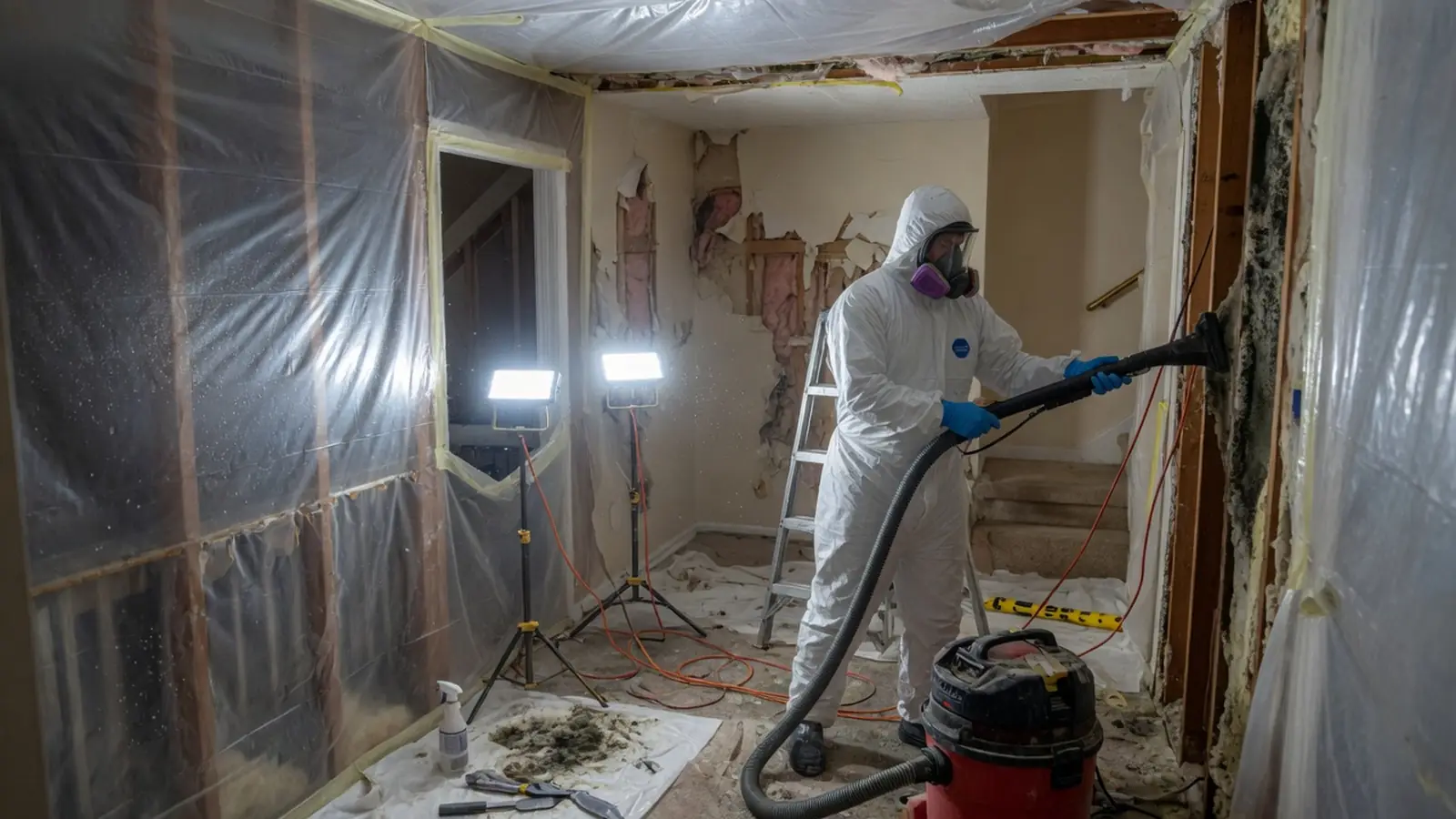
- Containment And Negative Air Setup. Professional mold remediation isolates contaminated spaces under negative air pressure with HEPA filtration to keep disturbed spores from circulating into clean living areas. Technicians seal doorways, air returns, and ventilation registers with heavy poly sheeting.
- Targeted Demolition And Stud Inspection. A pattern echoed in public discussions is that demolition of water-damaged drywall reveals heavy black mold infestation on wall framing and insulation, necessitating professional mold abatement. We safely bag and remove ruined porous boards before inspecting underlying framing.
- Antimicrobial Scrubbing And HEPA Vacuuming. Crews physically abrade infected timber surfaces with wire brushes and apply hospital-grade antimicrobial fungicides to kill microscopic fungal roots. Once dry, framing is cleaned with multi-stage HEPA vacuums to capture fine spores.
- Structural Drying And Clearance Verification. Industrial desiccant dehumidifiers run continuously until moisture meters show structural wood equilibrium below critical microbial thresholds. Final clearance air testing confirms airborne spore counts match or beat clean outdoor baselines.
Our Remediation Workmanship Standard
Our remediation protocols address moisture issues stemming from hidden plumbing leaks and frozen pipes before colonies spread through structural cavities. We never rely on superficial cosmetic sprays or quick surface painting to mask microbial contamination. Every project adheres strictly to physical containment, safe material extraction, and comprehensive antimicrobial sanitation to protect your building's structural integrity.
Containment And Air Scrubbing
We isolate contaminated areas using heavy plastic barriers and negative air pressure machines equipped with certified HEPA filtration. This containment prevents fungal spores and microscopic particulates from cross-contaminating pristine living quarters during active remediation.
Antimicrobial Surface Treatment
Technicians safely discard non-salvageable porous wallboard while treating framing lumber and subfloors with EPA-registered antimicrobial solutions. Thorough physical scrubbing and wire brushing remove deeply rooted fungal colonies from structural wood surfaces.
Structural Dehumidification And Drying
Commercial desiccant dehumidifiers and high-velocity air movers extract trapped moisture from subterranean foundation elements and structural cavities. Calibrated thermal imaging sensors and moisture meters confirm dry standards to prevent future fungal recurrence.
Our Commitment To Verified Remediation Standards
Every remediation project follows rigorous containment protocols and controlled moisture reduction standards. We focus on identifying underlying water intrusion sources and restoring clean, safe living environments without compromising structural integrity.
- 10Zip Codes Served
- 6Service Areas
- 3Services Offered
Local property owners rely on our certified remediation practices to eliminate stubborn fungal growth and protect indoor air quality. Here is what real clients share about their experiences working alongside our dedicated specialists.
“Another outfit offered a cheap spray-down that skipped containment, but this crew pointed out the active colonies behind the baseboards and set up proper negative air machines. They took the time to scrub the framing studs down to bare wood instead of just painting over the mildew. Spending a little more upfront saved me from having to rip out my finished basement twice.”
Marcus G.
“When evaluating replacement options after drywall removal, the technician explained why closed-cell spray insulation and fiber-cement backer board would prevent future fungal recurrence far better than standard fiberglass batts. That practical recommendation gave me complete confidence in the durability of our downstairs playroom. The team treated every exposed timber with antimicrobial sealant before finishing the job.”
Elena V.
“A sudden weekend torrential downpour flooded our narrow exterior basement stairwell right as the equipment was being unloaded, creating a tricky access problem. The crew adapted immediately by rerouting their heavy dehumidification lines through an egress window and working late into the evening to stay on schedule. Their rapid response prevented the spores from migrating into our main floor ductwork.”
Bradley K.
“Our shared townhouse association had strict rules regarding exterior HEPA exhaust vents and parking commercial vans along the courtyard drive. The team positioned their filtration exhaust quietly away from adjoining patios and kept the HOA board fully satisfied throughout the remediation. Everything was thoroughly cleaned, passed clearance testing, and left spotless.”
Diane T.
Frequently Asked Questions
Does drywall with visible mold growth have to be cut out and discarded, or can porous wallboard be treated and sealed like structural wood framing studs?
Porous drywall with visible mold must be cut out and discarded because fungal hyphae penetrate deep into gypsum, unlike solid structural wood studs. While non-porous and semi-porous framing can be scrubbed, disinfected, and sealed with antimicrobial coatings, porous wallboard cannot be completely decontaminated once colonized.
Can renting consumer dehumidifiers dry standing water, or is commercial drying equipment required to prevent mold colonization?
Commercial drying equipment is required because standard consumer dehumidifiers lack the airflow and moisture removal capacity to stop colonization. Residents question whether renting consumer dehumidifiers can adequately dry standing water or if commercial drying equipment is required to prevent mold colonization. As trade videos frequently demonstrate, household fans and shop vacs leave trapped moisture behind walls, making thermal cameras and industrial meters necessary to prevent hidden rot.
How long does professional mold abatement take from initial containment to clearance?
Standard residential containment and remediation projects typically require two to four days to complete structural drying and clearance testing. Timelines depend on the square footage involved, the depth of moisture saturation within framing, and the time required for industrial dehumidifiers to reach target dry standards.
What special precautions are required when remediating mold in older residential structures?
Remediation in homes built prior to 1980 requires testing for asbestos and lead before disturbing drywall, joint compound, or old pipe insulation. Because older regional housing units frequently contain legacy building materials, containment controls must prevent dispersing hazardous mineral fibers during demolition.
What factors determine the overall cost of a certified mold remediation project?
Remediation costs depend primarily on the physical area of growth, necessary material removal, equipment run time, and post-testing clearance needs. Uncomplicated localized infestations isolated behind single basement partition walls require far less labor and filtration time than widespread fungal contamination impacting HVAC distribution trunks.